Introduction
SWAP (Soil, Water, Atmosphere and Plant) simulates transport of water, solutes and heat in unsaturated/saturated soils. The model is designed to simulate flow and transport processes at field scale level, during growing seasons and for long term time series. It offers a wide range of possibilities to address both research and practical questions in the field of agriculture, water management and environmental protection.
Summary
This page provides summary information on the following subjects:
- Meta-information
- General focus of the model
- General context of use
- History of the model
- Systems, sub-systems,mechanisms considered in the conception of the model
- Concepts, modeling formalism
- Theory
- Architecture and modules of the model
- Policy variables and intervention measures
- Building the model
- Strengths and limitations of the model
- Downloads on internet
- Status A
Meta-information
| Name | SWAP 4 |
| Version | 4.3.0 (publicly available) |
| Release date | 2026-05-26 |
| Operability | SWAP 4 simulates transport of water, solutes and heat in the vadose zone. In SWAP 4 the crop growth model WOFOST is fully integrated (see Kroes et al., 2017), as well as a simple nitrogen module (Groenendijk et al., 2017). |
| Domain | SWAP 4 describes a domain from the top of canopy into the groundwater which may be in interaction with a surface water system. It is designed to simulate transport processes at field scale and during entire growing seasons. Multiple years with crop rotations can be considered. In the vertical direction the model domain reaches from a plane just above the canopy to a plane in the shallow groundwater. In this zone the transport processes are predominantly vertical, therefore SWAP is a one-dimensional, vertically directed model. In the horizontal direction, SWAP’s main focus is the field scale. |
| Temporal and spatial scale | In the vertical direction the model domain reaches from a plane just above the canopy to a plane in the shallow groundwater. In this zone the transport processes are predominantly vertical, therefore SWAP is a one-dimensional, vertically directed model. In the horizontal direction, SWAP�s main focus is the field scale. |
| Accuracy | The main governing equation is a highly non-linear partial differential equation that is numerically solved by minimizing mass balance errors. The user is able to define convergence criteria that determines the correctness of the solution. Furthermore, the problem is determined by the user-supplied information regarding time-varying boundary conditions. Errors in such input of course determine the simulation. |
| Required input | Water flow: - Daily evapotranspiration - Daily rainfall and/or irrigation data - Soil hydraulic properties - Drainage conditions Crop development: - Development stage during growing period - Leaf area index during growing period - Soil cover during growing period - Rooting depth during growing period - Sensitivity of crop root water extraction to high and low soil water pressure heads - Sensitivity of crop root water extraction to salinity concentrations (if applicable) Solute transport: - Initial solute concentrations in the soil - Amount of solute applications and/or solute concentration in irrigation water - Solute concentrations in groundwater See details in Kroes et al. (2017) and Groenendijk et al. (2016). |
| Model output | Time series of extended water and solute balances terms and crop dry matter development including relevant variables. See details in Kroes et al. (2017) and Groenendijk et al. (2017). |
| Keywords | soil water movement; evapotranspiration; soil hydraulic properties; drainage; crop development; root water uptake; agrohydrology; irrigation, solute transport; soil temperature |
| User interface | Communication between user and model uses ASCII-based files (no graphical user interface). |
| Programming language, development environment | SWAP is written in standard FORTRAN (mixed 90/95, 2003/2008). For file-IO we make use of TTutil, which is also written in FORTRAN. Compilation and (static) linking is mainly done using Intel Intel Parallel Studio XE 2019 Update 3 Composer Edition for Fortran Windows Integration for Microsoft Visual Studio 2017, Version 19.0.0051.15 under Microsoft Visual Studio Professional 2017. The same source has also been tested with compilation+linking using the GNU-fortran compiler, and with an intel and GNU compiler on Linux (Ubuntu). |
| Platform | Windows 10/11, Ubuntu |
| Availability | The official release can be downloaded from the SWAP website: swap.wur.nl. |
| Restrictions on use (legal) | This software is distributed under the terms of the GNU GENERAL PUBLIC LICENSE Version 3, June 2007. |
| Price | Free, see availability. |
| Contact | See availability. |
General focus of the model
SWAP (Soil-Water-Atmosphere-Plant) simulates transport of water, solutes and heat in the vadose zone in interaction with vegetation development. SWAP has been employed to explore alternative flow and transport concepts, to analyze laboratory and field experiments, and to evaluate management options with respect to field scale water and solute movement. In the horizontal direction, the main focus of SWAP is the field scale. Published, typical examples are given by Van Dam et al. (2008), Kroes et al. (2017) and Heinen et al. (2024) for:
- Field scale water and salinity management
- Irrigation scheduling
- Transient drainage conditions
- Plant growth affected by water and salinity
- Pesticide leaching to groundwater and surface water
- Regional drainage from top soils towards different surface water systems
- Optimization of surface water management
- Effects of soil heterogeneity
SWAP also serves to generate soil water fluxes for pesticide and nutrient models. The model can be used to explore new flow and transport concepts for agro- and ecohydrology and on the analysis of laboratory and field experiments.
General context of use
The SWAP model has a wide range of users:
- Basic research: analysis of laboratory and field experiments and exploration of new flow and transport concepts for agro- and ecohydrology.
- Applied research: irrigation and water management alternatives, precipitation excess during winter (relevant e.g. for nitrate and pesticide leaching); or, impact of hydrological conditions or climate change on crop production in project Watervision Agriculture (Waterwijzer Landbouw).
- Decision support: water management strategies at various scales, integral part of PEARL model (EU-level legislation of pesticides), ANIMO (nutrient cycle and leaching at field scale) and STONE model (national Dutch instrument for nutrient analysis from top soil to surface water).
- Educational and training: international training courses were given in the Netherlands, Poland, South Africa, Russia and Brazil.
History of the model
The soil hydrological model SWAP has a history of more than 50 years. The first version (called SWATR) was developed by Reinder Feddes and colleagues in The Netherlands and published in 1978. During it’s history regularly updates were spread with derived acronyms SWATRE, SWACROP, SWAP93, and SWAP: Feddes et al. (1978); Belmans et al. (1983); Wesseling et al. (1991); Kabat et al. (1992); Van den Broek et al. (1994); Van Dam et al. (1997); Kroes et al. (2001; 2003; 2008).
The previous standard Internet version was published as SWAP3.2.36 by Kroes et al. (2009). The current version is SWAP4.
Systems, sub-systems, mechanisms considered in the conception of the model
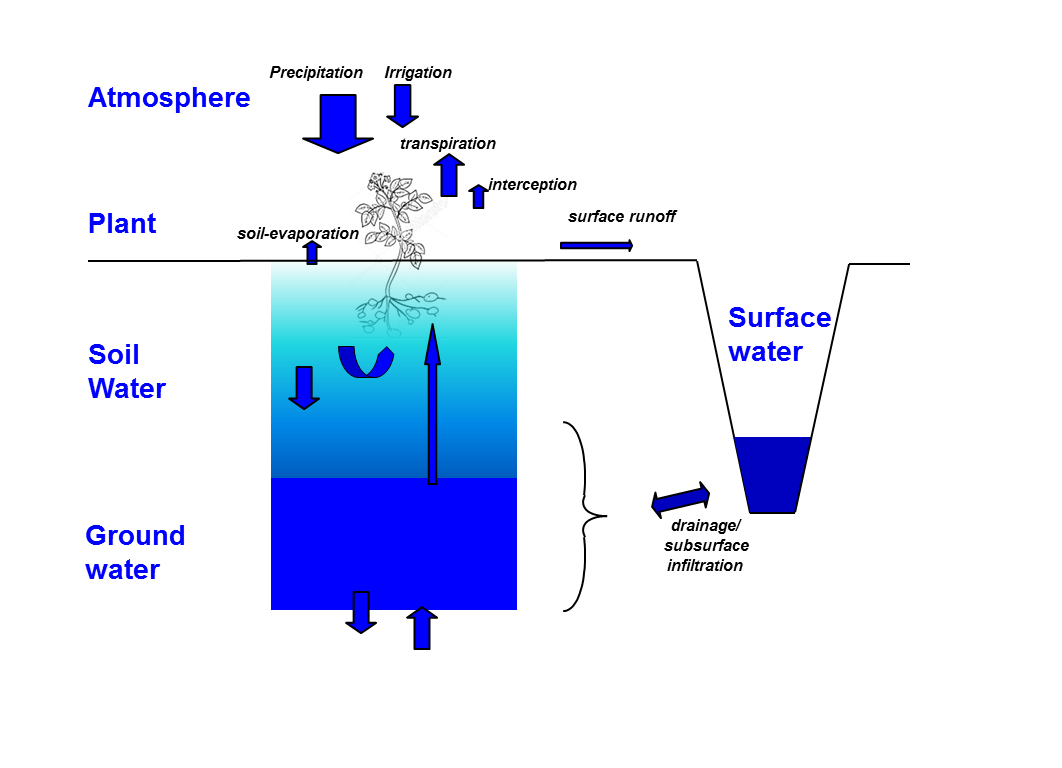
SWAP is a computer model that simulates transport of water, solutes and heat in variably saturated top soils. The program is designed for integrated modeling of the Soil-Atmosphere-Plant System. Transport processes at field scale level and during entire growing seasons are considered. System boundaries at the top are defined by the soil surface with or without a crop and the atmospheric conditions. The lateral boundary simulates the interaction with surface water systems. The bottom boundary is located in the unsaturated zone or in the upper part of the groundwater and describes the interaction with regional groundwater.
Concepts, modeling formalism
The SWAP model simulates physical processes related to: soil water flow, soil heat flow, solute flow, crop growth, macropore flow and interaction with groundwater and surface water systems. The modeling concepts of these processes are summarized below.
Soil water flow:
The versatile Richards’ equation is applied integrally for the unsaturated-saturated zone, with possible presence of transient and perched groundwater levels. Due to its physical basis, the Richards� equation allows the use of soil hydraulic functions from databases and simulation of all kinds of management options. Hysteresis of the retention function can be taken into account. Root water extraction at various depths in the root zone is calculated from potential transpiration, root length density and possible reductions due to wet, dry or saline conditions.
Soil heat flow:
Soil temperature may affect the surface energy balance, soil hydraulic properties, decomposition rate of solutes and growth rate of roots. Combination of a one-dimensional soil heat flux and the equation for conservation of energy yields the differential equation for soil heat flow. This equation can be solved analytically or numerically.
Solute flow:
SWAP simulates convection, diffusion and dispersion, non-linear adsorption, first order decomposition and root uptake of solutes. This permits the simulation of ordinary pesticide and salt transport, including the effect of salinity on crop growth. SWAP is able to simulate the water residence time in the saturated zone analogous to mixed reservoirs. In case of detailed pesticide transport or nutrient leaching, daily water fluxes can be generated as input for other transport models, such as the pesticide model PEARL and the nutrient model ANIMO.
Crop growth:
Crop growth can be simulated by a module based on the code WOFOST. The processes considered include rate of phenological development, interception of global radiation, CO2 assimilation, biomass accumulation of leaves, stems, storage organs and roots, leaf decay and root extension. The assimilation rate is affected by water and/or salinity stress in the root zone. If simulation of crop growth is not needed, the user should prescribe leaf area index, crop height and rooting depth as a function of development stage.
Macropore flow:
Macroporosity can be caused by shrinking and cracking of soil, by plant roots, by soil fauna, or by tillage operations. The macropore module in SWAP includes infiltration into macropores at the soil surface, rapid transport in macropores to deeper layers, lateral infiltration into and exfiltration out of the soil matrix, water storage in macropores, and rapid drainage to drainage systems. The macropores are divided in a main bypass domain (network of continuous, horizontal interconnected macropores) and an internal catchment domain (discontinuous macropores ending at different depths). The internal catchment domain causes infiltration of macropore water at different, relatively shallow depth. In addition, the macropores are divided in static and dynamic volumes. The dynamic volumes depend on shrinkage characteristics.
Surface water systems:
Drainage to or infiltration from surface water systems is calculated with 2-dimensional drainage equations, which allow evaluation of drainage design. The user may also specify a drainage resistance or tabular values of the drainage flux as a function of groundwater level. The groundwater system can be modeled at the scale of a subregion with different surface water systems and options for surface water management. Drainage/subsurface water discharged towards surface water systems can be simulated with different residence times.
Theory
Extensive theoretical information about modeled processes can be found at the page with references. This page gives an overview of modeled domain and type of proces description.
SWAP simulates transport of water, solutes and heat in the vadose zone in interaction with vegetation development. The model employs the Richards equation including root water extraction to simulate soil moisture movement in variably saturated soils. Concepts are added to account for macroporous flow and water repellency. SWAP considers for solute transport the basic processes convection, dispersion, adsorption and decomposition. For more extensive studies which for instance include volatilization or nutrient transformations, SWAP generates soil water fluxes for detailed chemical transport models as PEARL for pesticides and ANIMO for nutrients. SWAP simulates soil heat flow taking into account actual heat capacities and thermal conductivities. The generic crop growth module WOFOST is incorporated to simulate leaf photosynthesis and crop growth. The soil moisture, heat and solute modules exchange status information each time step to account for all kind of interactions. Crop growth is affected by the actual soil moisture and salinity status on a daily basis. An extensive test protocol ensures the numerical code quality of SWAP.
In the vertical direction the model domain reaches from a plane just above the canopy to a plane in the shallow groundwater (see Figure).
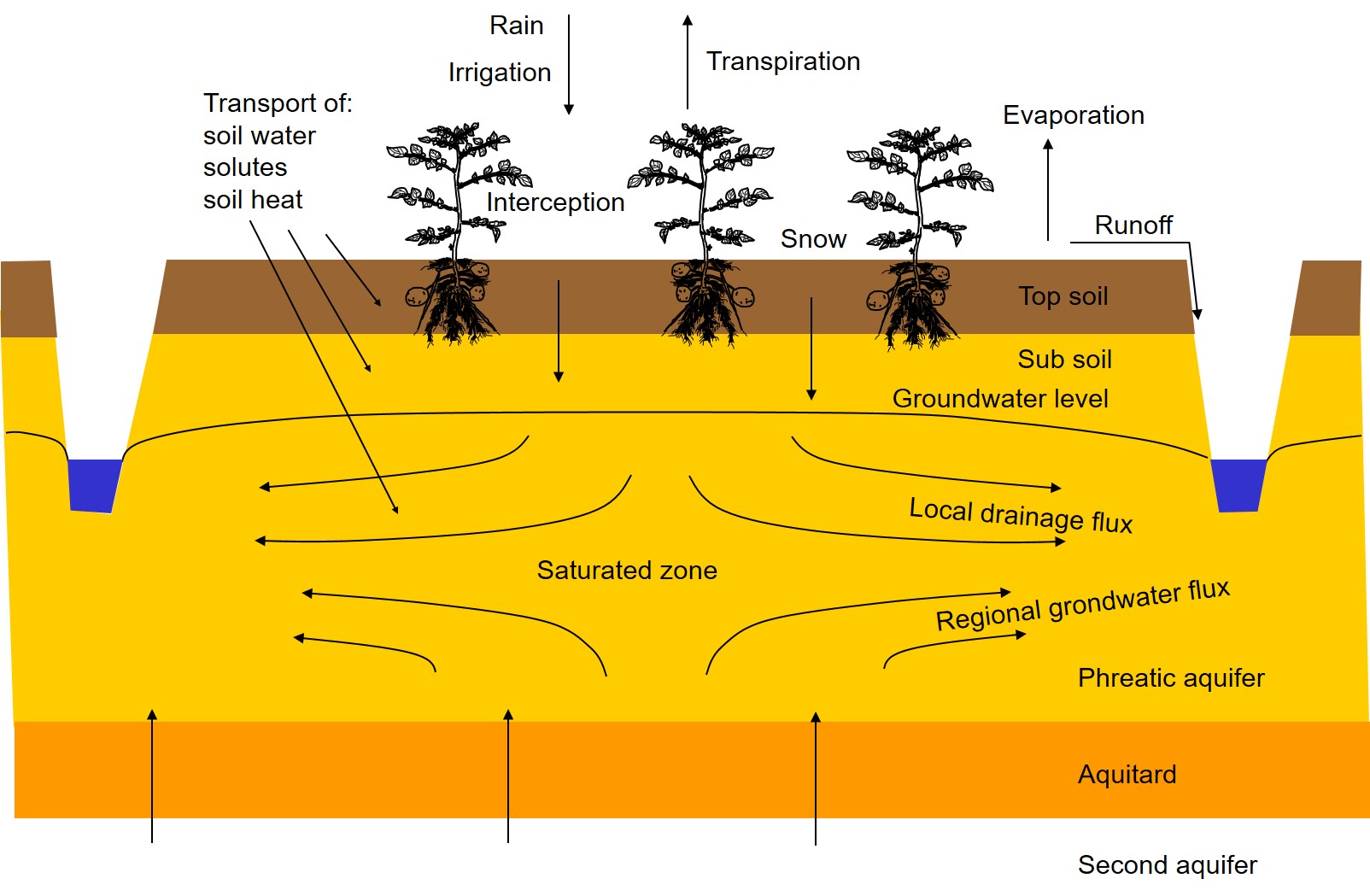
In this zone the transport processes are predominantly vertical, therefore SWAP is a one-dimensional, vertical directed model. The flow below the groundwater level may include lateral drainage fluxes, provided that these fluxes can be prescribed with analytical drainage formulas. The model is very flexible with regard to input data at the top and bottom of the soil column. At the top in general daily weather conditions will suffice. For Nordic conditions a simple snow storage module has been implemented. In case of more focussed studies (e.g. runoff or diurnal transpiration fluxes) evapotranspiration and rainfall data can be specified in more detail. At the bottom various forms of head and flux based conditions are used.
In the horizontal direction, SWAP’s main focus is the field scale. At this scale most transport processes can be described in a deterministic way, as a field generally can be represented by one microclimate, one vegetation type, one soil type, and one drainage condition. Also many cultivation practices occur at field scale, which means that many management options apply to this scale. Upscaling from field to regional scale for broader policy studies is possible with geographical information systems.
The smallest time steps in SWAP are in the order of seconds for fast transport processes such as intensive rain showers with runoff or flow in macroporous clay soils. These time steps are automatically increased in periods with less fluctuating flow conditions. Depending on simulation complexity, computation times for 50 year periods range from 30 to 500 seconds on ordinary personal computers
Architecture and modules of the model
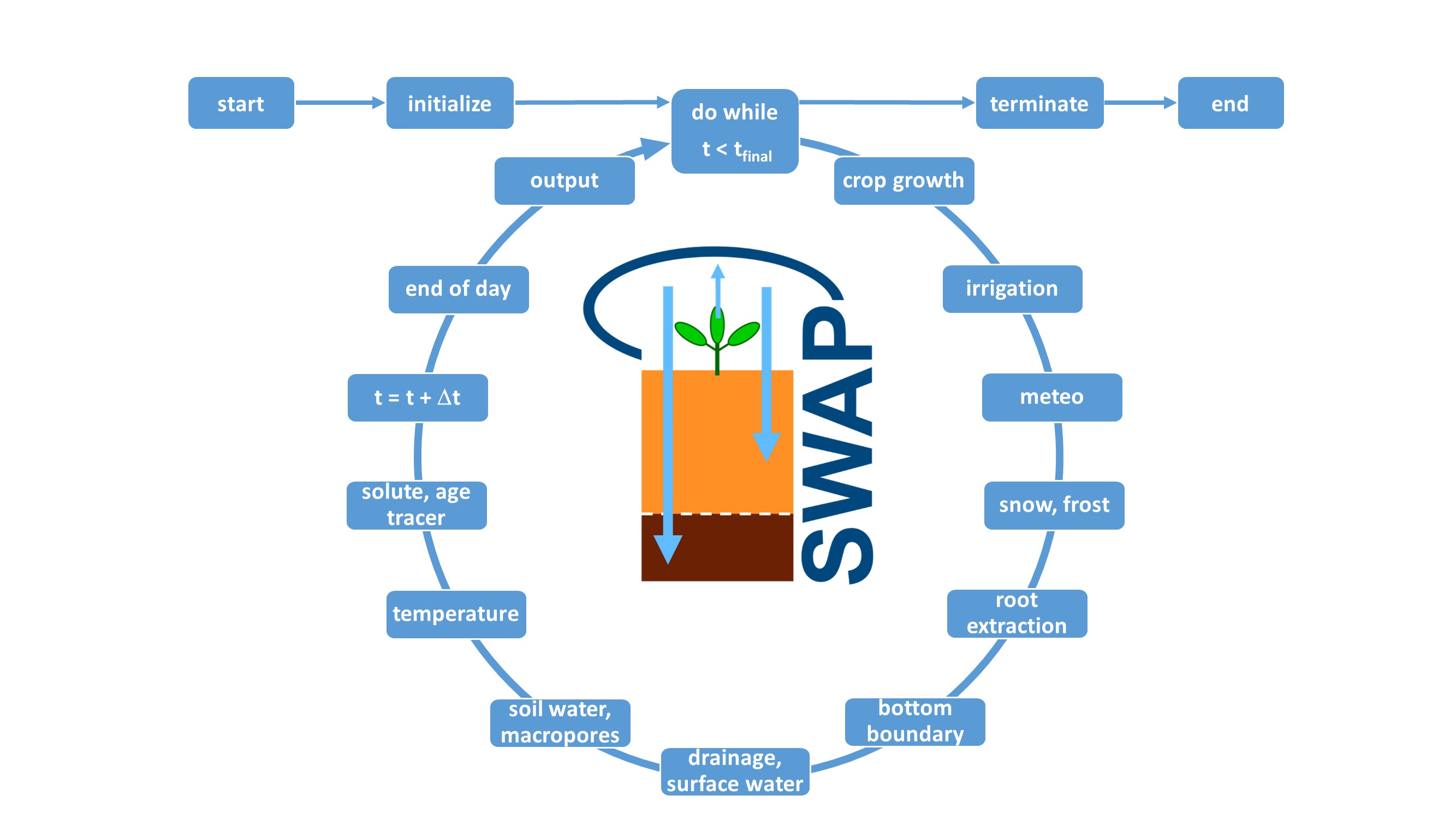
SWAP consists of clearly defined modules for soil water flow, soil heat flow, solute transport, crop growth, macropore flow and interaction with groundwater and surface water systems. An extensive description of SWAP4 is given by Kroes et al. (2017). The figure below provides the sequential flow chart along all components during a simulation.
Policy variables and intervention measures
All policy measures taken are related to water management issues. Examples are:
- influence of different land use on crop growth and crop production;
- impact of surface and ground water strategies on crop development.
Building the model
- Model parameters
- The model input parameters for soil hydrology and crop growth are described by Kroes et al. (2017).
- The model input parameters for soil-N, Soil-C and crop-N are described by Groenendijk et al. (2016).
- A sensitivity analysis was carried out by Finke et al. (1996) and Wesseling et al. (1998).
- Calibration and validation
- The model is distributed with a basic data set. As SWAP is a field scale model, most of the input parameters are clearly defined and can be measured separately. Input parameters may also be determined by inverse modeling. Documented experience is available on automated calibration using the PEST/SWAP combination, validation procedures and validation examples (Van Dam et al, 2008).
- Output and indicators
- The model output parameters are described by Kroes et al. (2017).
Strengths and limitations of the model
Water flow and solute transport in top soils are important elements in many environmental studies. The agro- and ecohydrological model SWAP (Soil-Water-Plant-Atmosphere) has been developed and is strong in simulation of simultaneously water flow, solute transport, heat flow, macropore flow and crop growth at field scale level.
For detailed pesticide and nutrient flow combination other transport models such as PEARL and ANIMO are recommended.
Application at a regional scale within a GIS-environment requires additional features that are not standard distributed with the model.
SWAP adheres to the open source philosophy. This allows other research teams to integrate the model into all kinds of Decision Support Systems. This has been done at various occasions (e.g. the PEARL team, PEARL). Recent versions of the model are distributed without a Graphical User Interface.
Downloads on internet
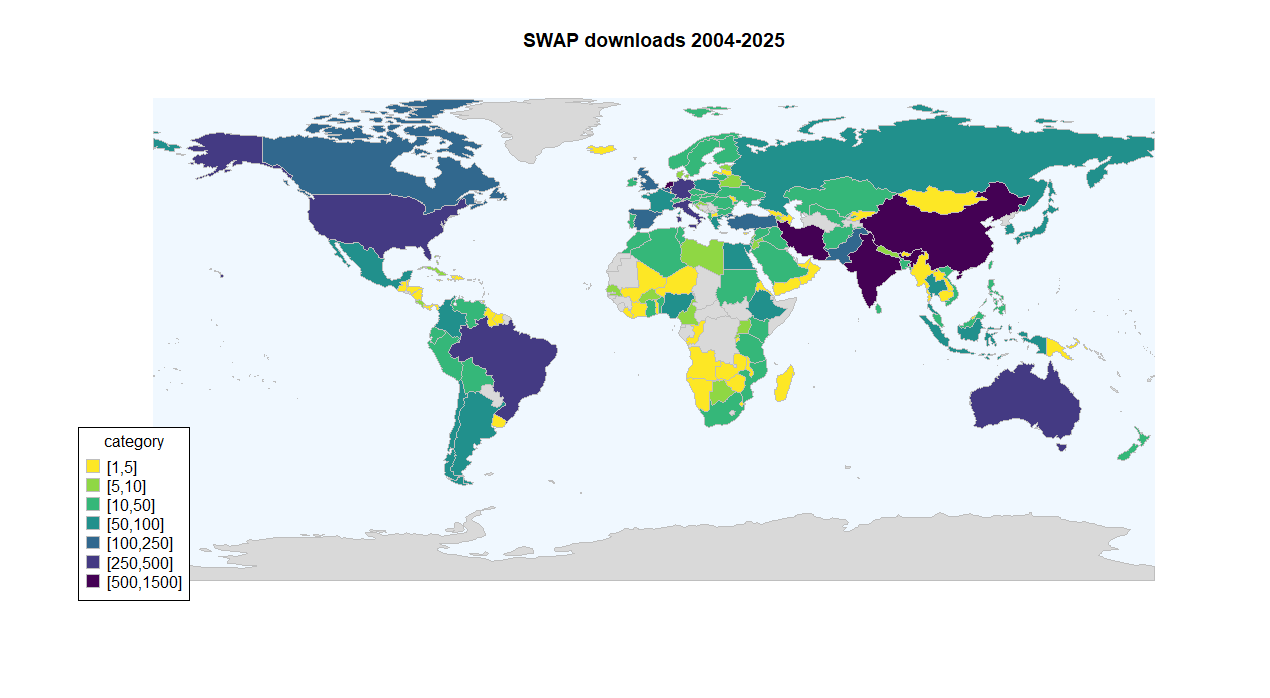
During the period 2004-2025 the model has been downloaded from more than 150 countries. The figure below shows the spatial distribution of unique SWAP downloads worldwide.
Status A
| Since 2021 SWAP obtained the qualification Status A from WUR. This means that SWAP has a basic quality standard that focuses on the completeness of documentation and the routine maintenance of the model. |  |