Short guide to use SWAP
1 Introduction
The model SWAP (Van Dam et al. 2008; Kroes et al. 2017; Heinen et al. 2024) simulates transport of water, solutes and heat in the vadose zone in interaction with vegetation development. The model employs the Richards equation including root water extraction to simulate soil moisture movement in variably saturated soils. Concepts are added to account for macroporous flow and water repellency. In case of solute transport, SWAP considers the processes convection, dispersion, adsorption and decomposition. For more detailed nutrient and pesticide studies, SWAP generates soil water fluxes for detailed chemical transport models such as PEARL for pesticides and ANIMO for nutrients. SWAP simulates soil heat flow taking into account actual heat capacities and thermal conductivities. The generic crop growth module WOFOST is incorporated to simulate leaf photosynthesis and crop growth. The soil moisture, heat and solute modules exchange status information each time step to account for all kind of interactions. Crop growth is affected by the actual soil moisture and salinity status on a daily basis. An extensive test protocol ensures the numerical code quality of SWAP.
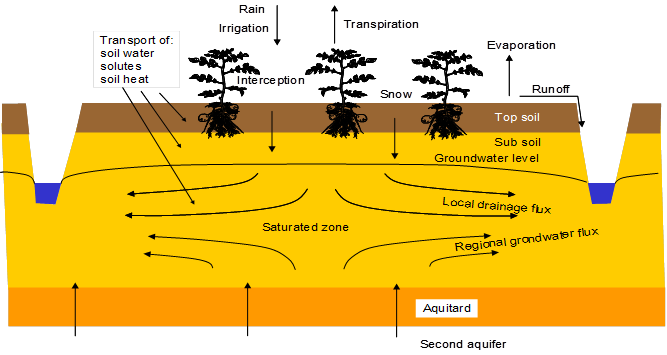
In the vertical direction the model domain reaches from a plane just above the canopy to a plane in the shallow groundwater (Figure 1.1). In this zone the transport processes are mainly vertical. Therefore SWAP is a one-dimensional, vertical directed model. The flow below the groundwater level may include lateral drainage fluxes, provided that these fluxes can be prescribed with analytical drainage formulas. The model is very flexible with regard to input data at the top and bottom of the soil column. At the top in general basic weather data will suffice. For Nordic conditions a simple snow storage module has been implemented. In case of more focussed studies (e.g. runoff or diurnal transpiration fluxes) evapotranspiration and rainfall data should be specified in time intervals less than a day. At the bottom various forms of head and flux based conditions are used.
In the horizontal direction, SWAP’s main focus is the field scale. At this scale most transport processes can be described in a deterministic way, as a field generally can be represented by one microclimate, one vegetation type, one soil type, and one drainage condition. Also many cultivation practices occur at field scale, which means that many management options apply to this scale. Scaling up from field to regional scale for broader policy studies is possible with geographical information systems.
The smallest time steps in SWAP are in the order of seconds for fast transport processes such as intensive rain showers with runoff or flow in cracked clay soils. These time steps are automatically increased in periods with less fluctuating flow conditions.
SWAP is developed and maintained by Wageningen University and Research centre. The model is spread as public domain software, including the source code. The website of SWAP contains detailed information of the model, example input files and the model itself.
This short guide is written to support basic use of the SWAP model.